


Action for SonicWall administrators: check the SonicOS build, SSL-VPN configuration, and whether SAML authentication is enabled. CVE-2026-19868 can let an attacker who already possesses valid credentials for an alternative authentication method bypass the SAML-enforced multifactor authentication (MFA) requirement on affected SonicWall SSL-VPN deployments. The U.S. Cybersecurity and Infrastructure Security Agency (CISA) added this vulnerability to its Known Exploited Vulnerabilities (KEV) catalog on November 6, 2026.
This is not a claim that anyone can connect without any credentials. The distinction matters: a valid credential may be accepted through an alternate path that does not enforce the expected SAML/MFA policy. Even organizations that require MFA should check their firmware and configuration.
Information checked: November 7, 2026. This article adapts our original Japanese-language report for English-speaking IT teams, based on SonicWall’s advisory and CISA’s KEV listing. Specific victims, the precise exploitation procedure, and Japan-specific incident totals have not been publicly established in the sources reviewed.
Is my SonicWall firewall affected? Check these versions first
| Item | What to check |
|---|---|
| Products | SonicOS Gen 7 and Gen 8 firewalls, including applicable physical and virtual appliances |
| Relevant feature | SSL-VPN using SAML authentication |
| Affected Gen 7 builds | 7.3.3-7015 and earlier |
| Fixed Gen 7 builds | 7.3.4-7013 and later |
| Affected Gen 8 builds | 8.2.2-8015 and earlier |
| Fixed Gen 8 builds | 8.2.3-8015 and later |
| Exploitation status | CISA KEV entry added November 6, 2026 |
| Primary vendor advisory | SonicWall SNWLID-2026-0014 |
A SonicOS build such as 8.2.2-8015 is still in the affected range; it is not the fixed 8.2.3 build. Confirm the supported upgrade path for your particular appliance and its release notes. If you do not use SAML with SSL-VPN, the authentication conditions described for this CVE may not apply, but the same multi-vulnerability SonicWall advisory still warrants review.
What administrators should do now
1. Inventory all exposed SonicWall devices
Start with your asset inventory, site network diagrams, virtual appliances, standby units and any branch-office firewalls. Record the exact SonicOS build and whether each device accepts internet-facing SSL-VPN connections. Verify the details in the management interface or with your support provider; display paths differ by device and release.
2. Review SSL-VPN and SAML authentication
Determine whether SSL-VPN is enabled, which sources may connect, whether SAML is the intended identity provider, and whether alternative authentication methods remain enabled. Record the current configuration and a rollback plan before changing production access controls.
3. Install a vendor-fixed SonicOS release
Update affected Gen 7 installations to 7.3.4-7013 or later and Gen 8 installations to 8.2.3-8015 or later, following SonicWall’s supported procedure. SonicWall has not published a confirmed workaround for this CVE. Treat temporary access restrictions as risk reduction—not a substitute for the patch.
- Review the model, maintenance entitlement, current build, release notes and any intermediate upgrade prerequisites.
- Back up the configuration and document recovery and escalation contacts.
- Schedule an outage window and account for expected disconnection of remote VPN users.
- For high-availability pairs or virtual appliances, check the vendor’s upgrade sequence and compatibility guidance.
- After the upgrade, confirm the reported build and test the SAML/MFA experience with a permitted account.
4. Investigate suspicious VPN activity
A successful firmware update does not demonstrate that no compromise occurred before it. Examine SSL-VPN logins and failures, source IP addresses, account identities, timestamps, device events and downstream access where logging is available. Review the corresponding identity-provider logs and time synchronization as well.
A VPN success entry without an expected SAML identity-provider event deserves investigation, but a missing IdP log by itself does not prove exploitation. Consider log retention, clock differences and configuration changes before attributing an event.
5. Respond to a suspected compromise
If the review identifies unexplained connections, preserve relevant logs and configuration snapshots, contain suspicious sessions, assess which internal resources were reached, disable or reset affected credentials where appropriate, and involve incident responders. Avoid destroying potentially important evidence through an unplanned factory reset.

How can a SAML MFA requirement be bypassed?
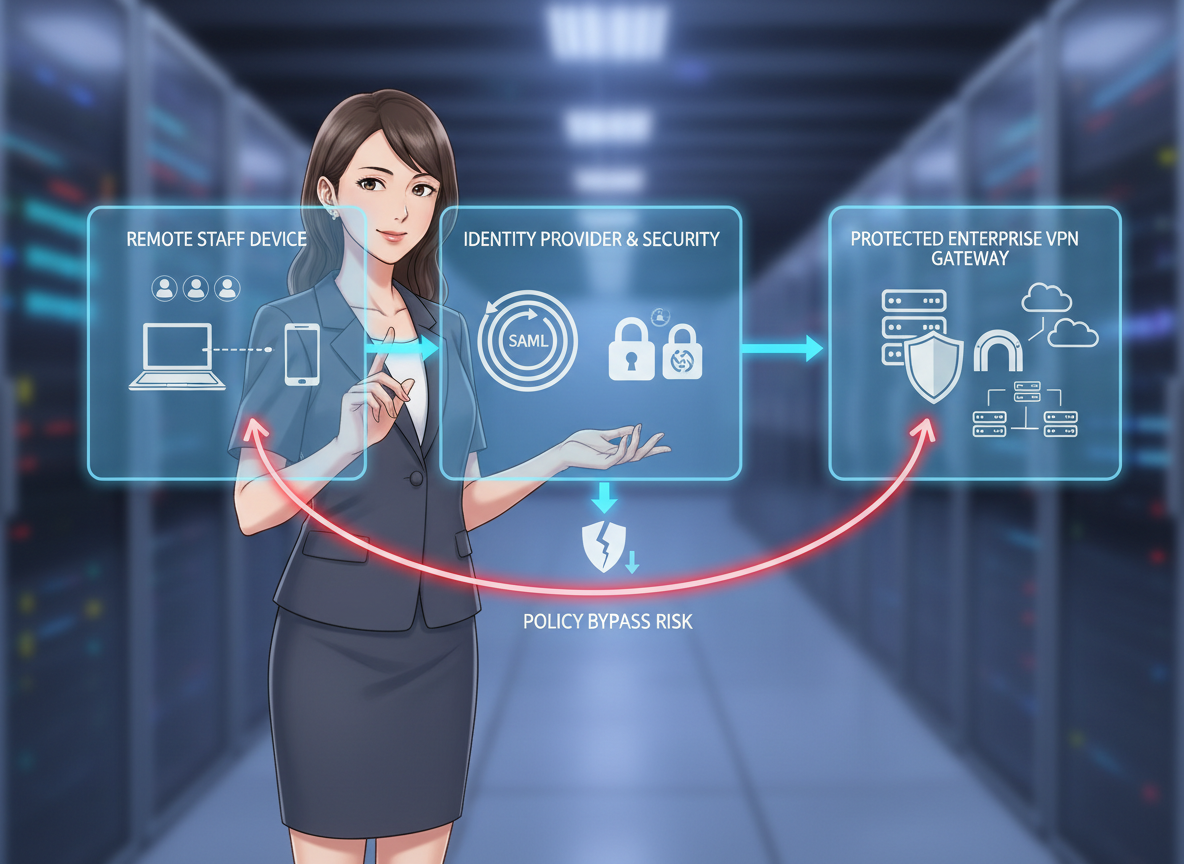
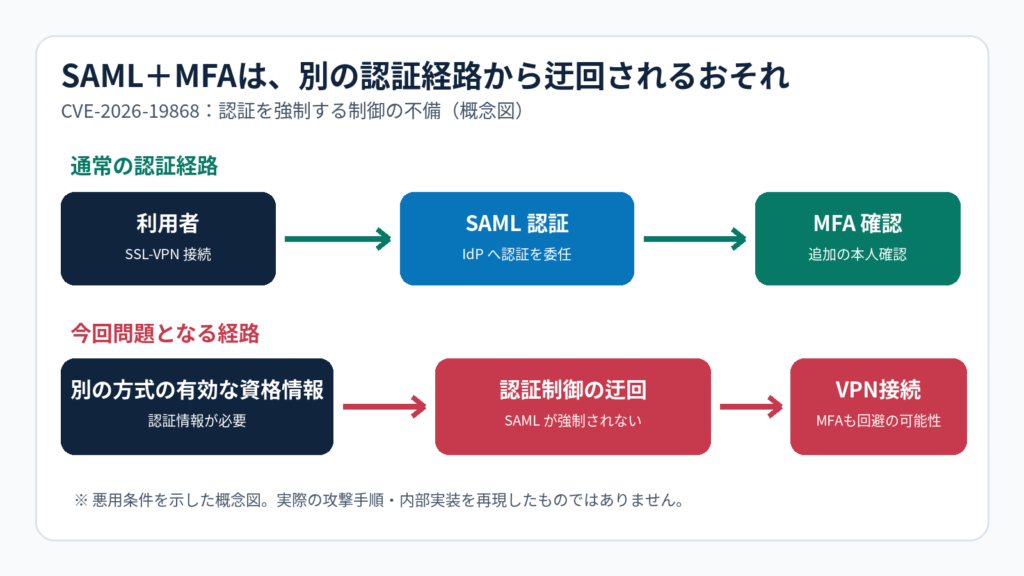
SSL-VPN lets authorized users connect remotely to private network resources. With SAML, the firewall delegates user authentication to an identity provider (IdP), which can require MFA. CVE-2026-19868 concerns an authentication-policy weakness: when a different authentication mechanism accepts valid credentials, the flow may fail to enforce the expected SAML/MFA requirement.
The MFA factor itself does not necessarily need to be defeated. The risk is that the intended authentication route and its mandatory MFA checks are not consistently enforced across possible sign-in routes. The vulnerability is categorized as CWE-308, Use of Single-factor Authentication. Vendor materials do not provide grounds to assume every affected organization suffered an intrusion.
CISA confirmed exploitation: what does the November 20 deadline mean?
CISA’s KEV catalog identifies vulnerabilities with evidence of exploitation. The entry for CVE-2026-19868 was added on November 6, 2026, with a remediation due date of November 20, 2026 for covered U.S. federal agencies under the applicable directive. That date is not a universal legal deadline for every private-sector organization, but internet-facing VPN systems should be prioritized without delay.
CISA’s catalog does not establish that ransomware was used against every victim; the ransomware-use field is listed as unknown. No reliable victim count or comprehensive exploitation timeline was established in the reviewed notices.
What if the upgrade cannot happen immediately?
Work with the network owner and vendor to evaluate temporary reductions in SSL-VPN exposure, source restrictions and disabling unnecessary remote access routes. These steps may reduce exposure but are not a vendor-validated fix for CVE-2026-19868. Do not blindly disable SAML or downgrade authentication security. Track the compensating controls, business impact and a firm remediation plan.
Frequently asked questions
Can an attacker exploit this without any login credentials?
The published description requires valid credentials for an alternative authentication method. It should not be described as unauthenticated access by an arbitrary internet user.
Is MFA alone enough?
No. The weakness can bypass a SAML-enforced MFA requirement on affected configurations. Patch affected SonicOS builds and verify the actual sign-in paths.
Does the issue affect SMA 100 or SMA 1000?
The cited SonicOS advisory identifies Gen 7 and Gen 8 firewalls. It does not establish SMA 100/1000 as affected by this same CVE. Review the separate advisories for those appliances.
Do I still need to investigate if the firmware is patched?
Yes. Patching prevents the identified vulnerability from remaining open, but it does not retrospectively establish that credentials or network resources were never accessed.
Summary and sources
Prioritize four questions: Which Gen 7/Gen 8 devices and builds do we run? Is SSL-VPN using SAML? Have we installed a fixed release? Do the access logs show signs of earlier unauthorized use? Assess externally exposed systems and exploitation evidence alongside numerical vulnerability scores.
- SonicWall PSIRT: SNWLID-2026-0014
- SonicWall support: SonicOS 7.3.4 / 8.2.3 security advisory
- CISA Known Exploited Vulnerabilities catalog: CVE-2026-19868
- NVD: CVE-2026-19868
- Read the original article in Japanese
Editorial note: English adaptation checked November 7, 2026. Technical illustrations are explanatory artwork, not actual device screenshots or exploit reproductions. Always follow current SonicWall release guidance.