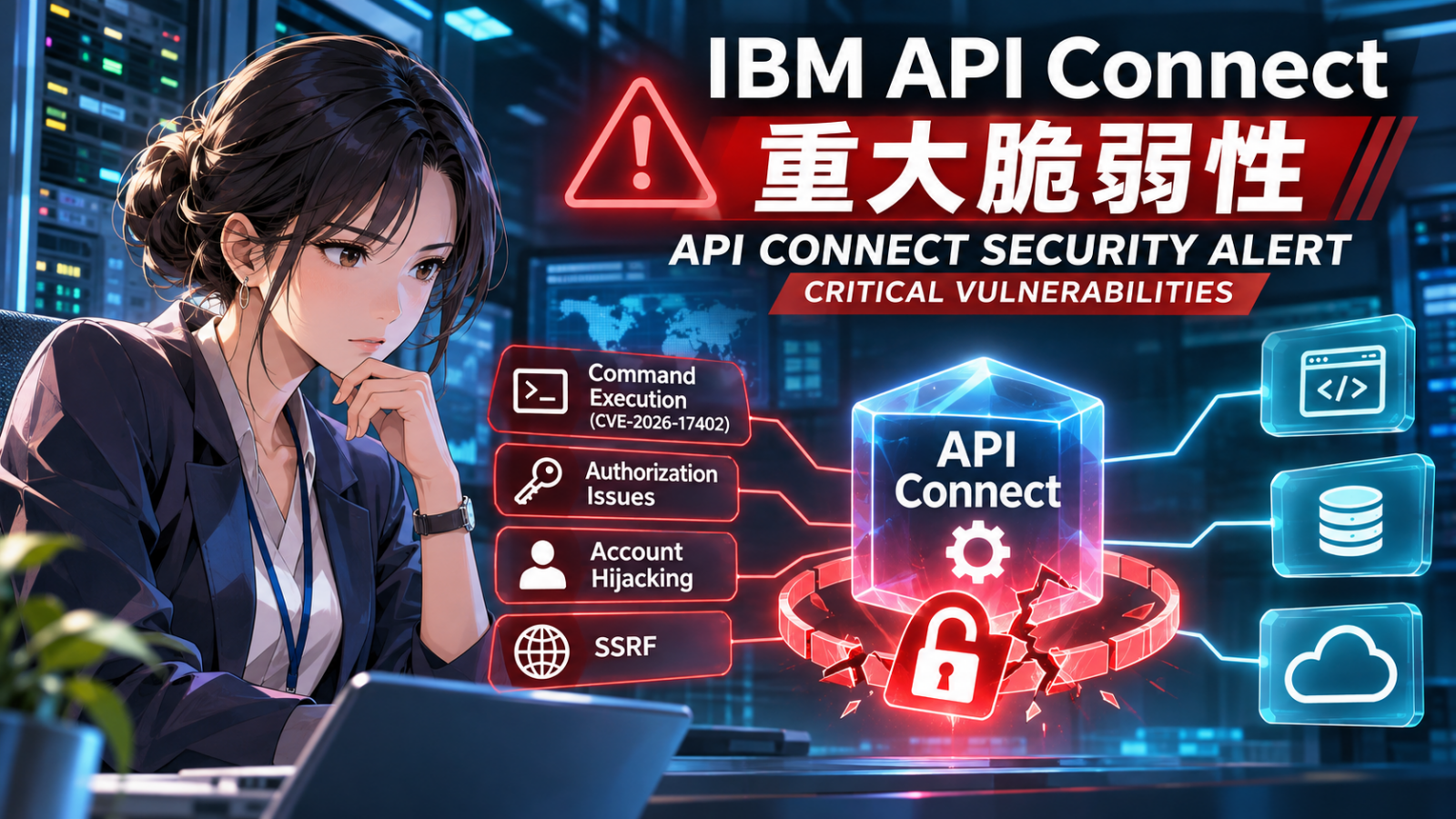


Action for IBM API Connect administrators: identify your exact release and applied interim fixes, then schedule the appropriate IBM updates. On November 5, 2026, IBM published security bulletins covering numerous API Connect vulnerabilities, including OS command injection (CVE-2026-17402, CVSS v3.1 9.9), an account-takeover risk involving redirects, server-side request forgery (SSRF), and cross-tenant resource access.
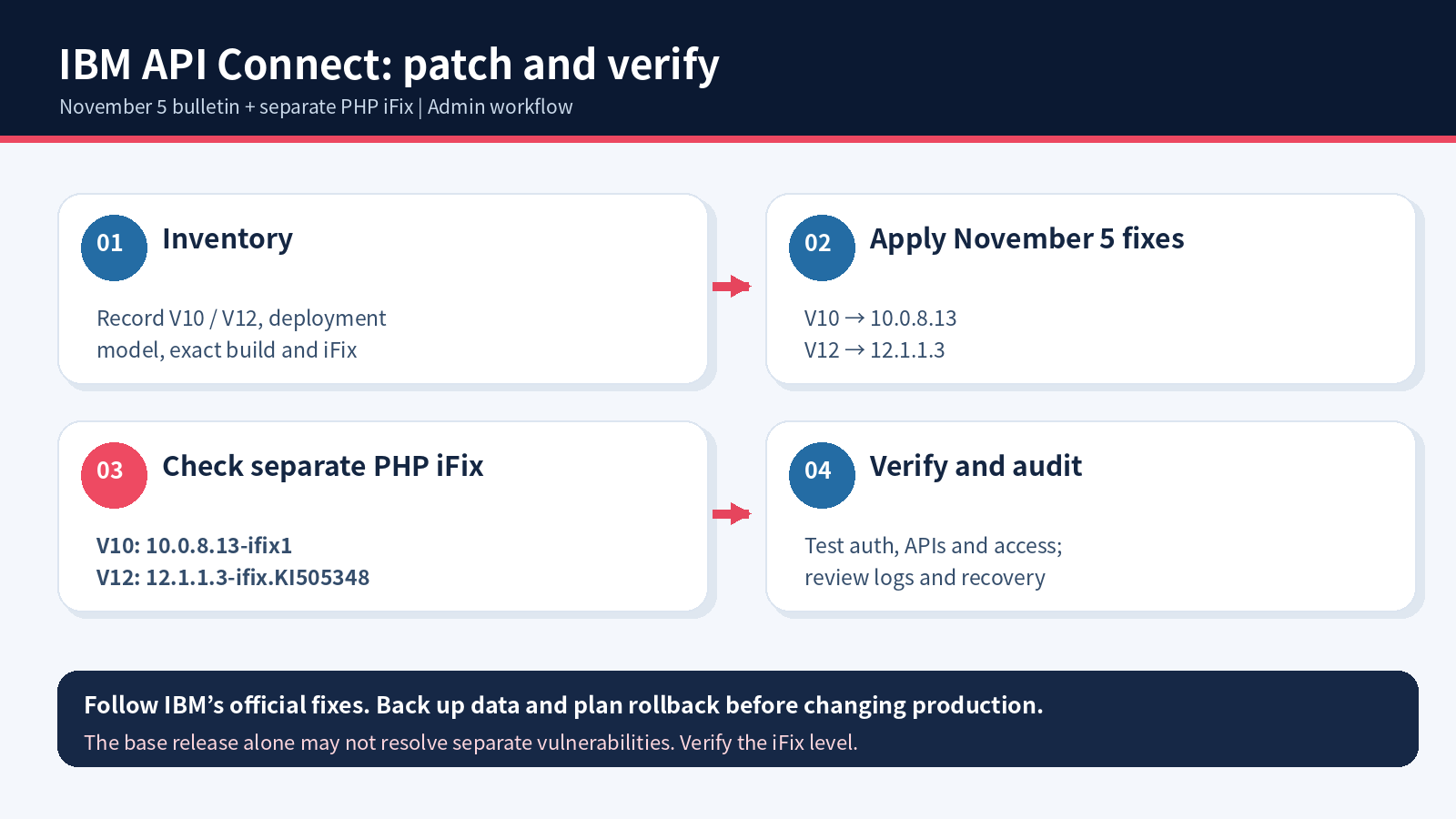
IBM identifies API Connect V10 10.0.8.0–10.0.8.12 and V12 on-premises 12.1.0.0–12.1.1.2 as affected by this advisory set. The corresponding fixed releases are 10.0.8.13 and 12.1.1.3. Do not stop there: a separate October 22 PHP bulletin includes those same base releases and provides additional iFixes. IBM lists no workaround for either advisory.
This English-language investigation guide adapts our Japanese report for global IT operations and incident-response teams. Last checked: November 8, 2026 (JST). A published vulnerability does not mean a particular organization has been compromised; we could not substantiate confirmed exploitation of these specific CVEs or a victim count from the official bulletins reviewed.
Affected versions: is your IBM API Connect installation vulnerable?
| Product line | Affected versions | Fixed for Nov. 5 vulnerabilities | Vendor bulletin |
|---|---|---|---|
| IBM API Connect V10 | 10.0.8.0–10.0.8.12 | 10.0.8.13 | IBM V10 bulletin |
| IBM API Connect V12 on-premises | 12.1.0.0–12.1.1.2 | 12.1.1.3 | IBM V12 bulletin |
Check the running product and patch level, not just a planned deployment or a console screenshot from months ago. Account for production, disaster recovery, non-production, and systems managed by a service provider. IBM explicitly labels the V12 product scope OnPrem; do not assume that every SaaS environment has identical exposure. An unsupported or extended-support release not listed here has not thereby been declared safe.
Critical correction: 10.0.8.13 and 12.1.1.3 are not universally ‘fully patched’
IBM’s separate October 22 advisory addresses PHP vulnerabilities CVE-2026-109618 and CVE-2026-109619 (PHP Group CVSS v4.0 9.2 each). It includes V10 10.0.8.13 and V12 12.1.1.3 in its affected ranges and directs administrators to additional fixes, including v10.0.8.13-ifix1 and v12.1.1.3-ifix.KI505348. A successful upgrade for the November 5 CVEs is not proof that these separate PHP issues have been resolved. Verify the correct iFix for your exact installed release.
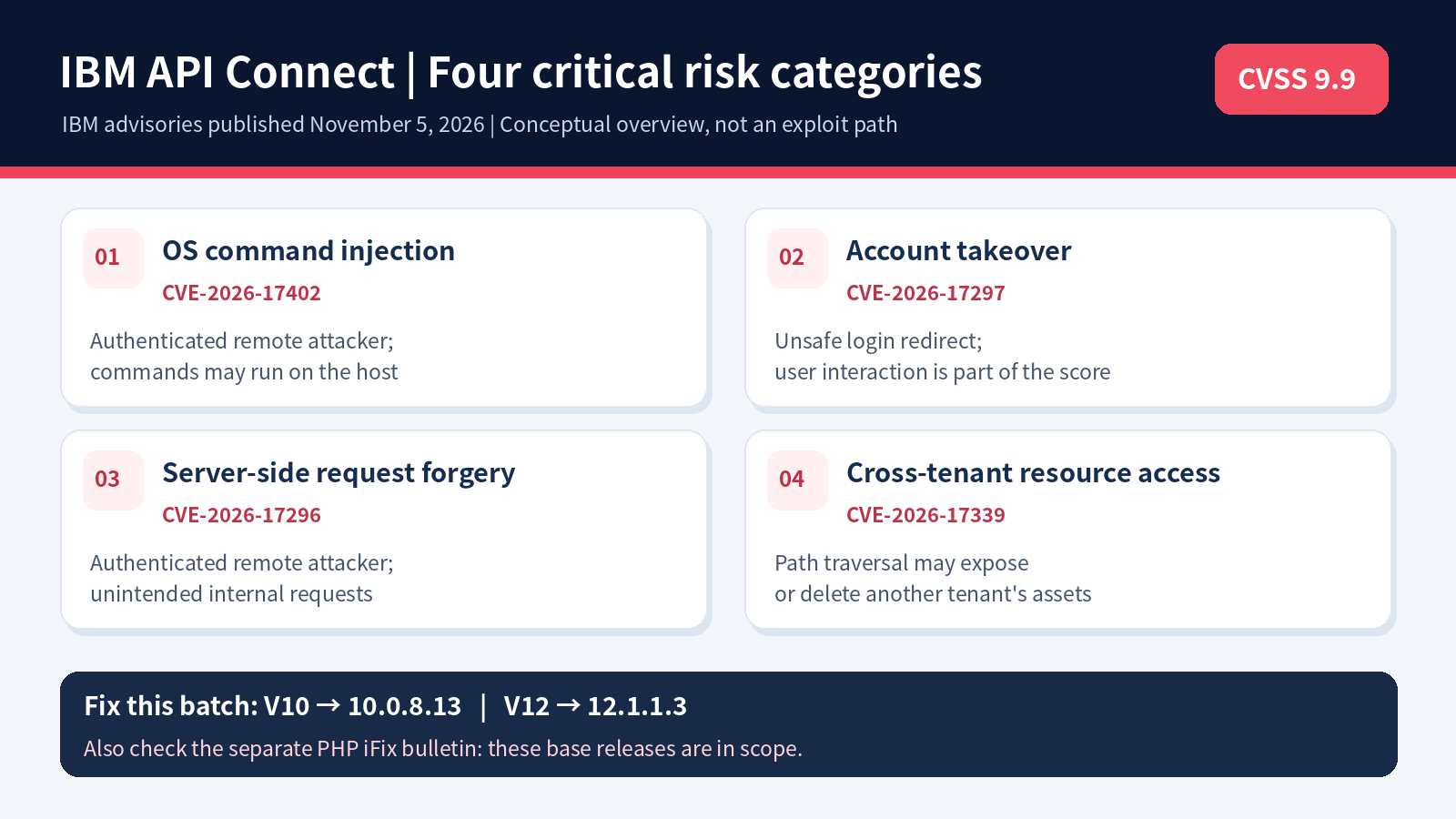
Five CVEs administrators should prioritize understanding
| Vulnerability | CVSS v3.1 | Attack condition and impact |
|---|---|---|
| CVE-2026-17402 — OS command injection | 9.9 | Remote authenticated attacker; improperly neutralized input could run commands on the underlying operating system (CWE-78). |
| CVE-2026-17297 — unsafe authentication redirect | 9.6 | An improperly checked sign-in redirect may send authentication results to an attacker-controlled endpoint, enabling account takeover. The published vector includes user interaction (UI:R). |
| CVE-2026-17296 — SSRF | 9.6 | Remote authenticated attacker may cause unintended server-side requests and information exposure (CWE-918). |
| CVE-2026-17339 — cross-tenant path traversal | 9.1 | Remote authenticated attacker may access or delete another tenant’s resources (CWE-22). |
| CVE-2026-17301 — signature validation / authentication bypass | 9.8 | Remote unauthenticated attacker could bypass authentication due to improper cryptographic signature verification (CWE-347). |
Important distinction: the highest score, CVSS 9.9, does not mean every vulnerability is remotely exploitable without credentials. CVE-2026-17402 is assessed with PR:L, while CVE-2026-17301 is assessed with PR:N and UI:N. Use attack prerequisites, network reachability, available privileges, and business criticality alongside severity scores. The bulletins contain additional CVEs; the table is a selected list, not a complete inventory.
Why API management vulnerabilities matter
An API management platform sits at an important administrative boundary: teams manage API definitions, access policies, credentials, developer onboarding, and organizational separation. An authorization flaw may permit operations beyond a user’s intended tenant; a command-injection flaw may threaten the host; and an SSRF flaw may let an application server contact internal services that a remote actor cannot reach directly. These are distinct weakness classes, not a confirmed chained attack observed at a particular customer.
SSRF is not the same as an exposed API endpoint
With SSRF, the affected server becomes the requester, potentially contacting internal URLs or other restricted destinations. An external exposure scan alone may not identify all reachable internal targets. Network egress restrictions and segmentation can reduce certain risks, but neither is an IBM-confirmed substitute for the fix.
Multi-tenant authorization requires server-side checks
A multi-tenant product must verify that every operation is authorized for the specific tenant and object, not just that a caller has a valid account. A seemingly ordinary authenticated user can be dangerous if object IDs, paths, or organization context are improperly trusted.
Immediate remediation checklist for platform owners
- Inventory deployments. Identify every V10 and V12 deployment, including management endpoints, developer portals, non-production environments, disaster-recovery systems, and installations operated by partners.
- Record the exact build and iFix history. Use the product administration tools and your configuration records. Avoid copying undocumented CLI commands between different deployment models.
- Match the applicable advisories. Review the V10 bulletin, V12 bulletin, and separate PHP iFix bulletin. Document which fix applies to each deployment.
- Plan a controlled change. Back up configurations and management data; check supported upgrade paths, component compatibility, outage windows, and a tested rollback strategy with IBM or your support partner.
- Apply vendor-provided updates. For the November 5 issues, target 10.0.8.13 or 12.1.1.3 as applicable, followed by relevant iFixes for separate issues. Do not assume a base release number records every interim fix.
- Verify services after patching. Check the reported version and fix level, authentication and OAuth flows, API requests, portal sign-in, organization boundaries, monitoring, and backup readiness.
IBM states no vendor workaround in the applicable bulletins. Restricting administrative access, reducing exposed interfaces, tightening access rights, and limiting outbound destinations can be considered as compensating risk-reduction controls while updates are scheduled. They should never be presented as verified patches or reasons to indefinitely defer maintenance.
What should defenders look for in logs?
- Unexpected management or developer-portal sign-ins, newly granted roles, identity or organization changes.
- Changes to OAuth redirect addresses, identity-provider settings, tokens, certificates, keystores, or other sensitive configuration.
- Changes to API definitions, catalogs, organizations, and resources owned by a different tenant.
- Unexpected outbound requests from application hosts toward internal services, plus unusual host-level process or system events where monitored.
- Timing mismatches between configuration changes, approved changes, audit logs, and known-good backups.
These are general defensive investigation pivots, not published indicators of compromise for the CVEs. Logging coverage varies by component, configuration and retention period. A clean log review does not prove there was no prior exploitation. If suspicious changes emerge, preserve evidence before broad remedial actions, assess downstream access, and involve the incident-response team and product support.
A practical change ticket for your IBM support provider
Request a written assessment covering: the installed API Connect version/build; V10 or V12 and on-premises applicability; Nov. 5 CVEs including CVE-2026-17402; the Oct. 22 PHP vulnerabilities and appropriate iFix; required download and entitlement; component-specific upgrade steps; planned downtime; backup and rollback; post-upgrade functional tests; and the scope of retrospective log review. Require confirmation of both the base version and applied interim fixes.
FAQ
Does CVE-2026-17402 allow unauthenticated arbitrary command execution?
IBM describes this specific CVE as exploitable by a remote authenticated attacker. Other flaws in the bulletin, including CVE-2026-17301, have different prerequisites. Do not combine their properties into one hypothetical exploit and present it as observed.
Is version 10.0.8.13 safe without additional fixes?
It is IBM’s fixed version for the November 5 advisory set. However, the separate October 22 PHP bulletin includes 10.0.8.13 in its affected range and supplies iFix instructions. Confirm exactly which fixes your environment has applied.
Are all IBM Cloud / SaaS API Connect tenants affected?
The cited V12 bulletin specifically scopes the affected product as on-premises. It is not evidence that every hosted deployment is affected in the same way. Ask the service provider for its security-status statement and verify the relevant deployment model.
Is active exploitation confirmed?
The IBM advisories reviewed here describe vulnerabilities and remediation, not a substantiated campaign or named victim list for these CVEs. Do not equate a high CVSS score with confirmed exploitation. Recheck vendor and national CERT notices for subsequent evidence.
Bottom line
Check exposure, patch the November 5 vulnerabilities, verify October’s separate PHP iFix, and investigate relevant administrative activity. Treat the required fixes as a configuration-management task as well as a security incident-prevention task. The distinction between authenticated command execution and unauthenticated authentication bypass should shape your risk assessment.
Primary sources and revision history
- IBM Security Bulletin — API Connect 10.0.8.13 (published November 5, 2026)
- IBM Security Bulletin — API Connect V12 on-premises 12.1.1.3 (published November 5, 2026)
- IBM Security Bulletin — Two Critical PHP Vulnerabilities and iFixes (published October 22, 2026; modified October 24)
- Original Japanese-language investigation
English edition checked November 8, 2026 (JST). Technical visualizations are explanatory illustrations, not real product screenshots, observed exploit flows or proof of a breach. Always refer to IBM’s latest support notices before production changes.