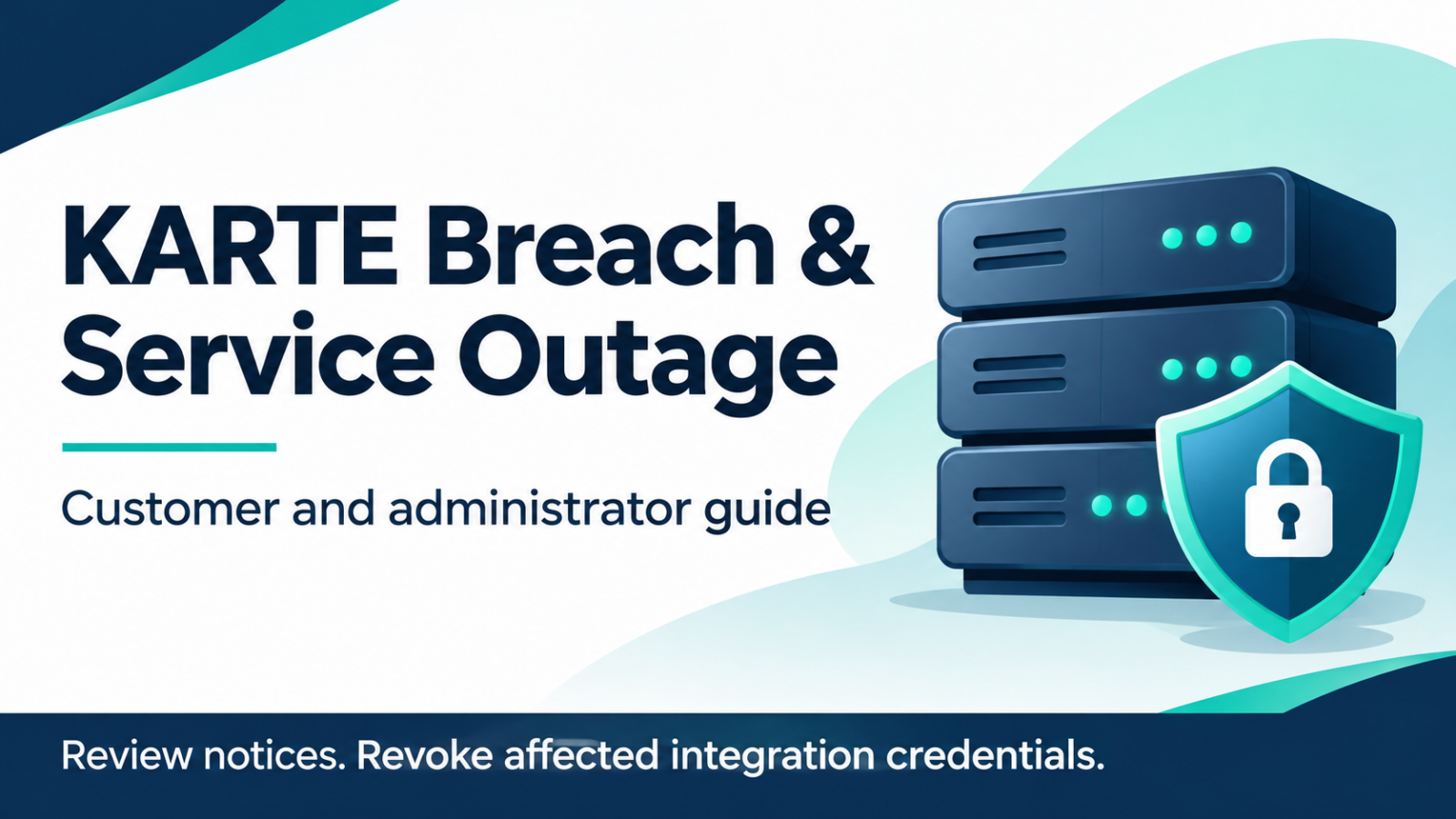


PLAID has confirmed a breach involving KARTE account information, integration credentials and some customer-uploaded data. Administrators should review individual notices, revoke affected external-service credentials and preserve job history. Customers of businesses using KARTE should follow the notice from that business.
Updated November 20, 2026 (JST): PLAID now targets a phased KARTE service restart from mid-January 2027. This is a target, not a confirmed recovery date. The company says structural security improvements and verification are required before restarting. See PLAID’s November 20 investigation report and the live status page for subsequent updates.
What has PLAID confirmed?
According to PLAID’s November 16 disclosure, an attacker exploited a server vulnerability, stole connection credentials, read data externally and used stolen credentials to access the administration interface. The company detected access November 13 at 08:59 JST and began stopping servers around 14:27.
| Confirmed category | Scope |
|---|---|
| KARTE account email addresses | 79,249 addresses; these are KARTE account registrations. |
| External integration credentials | Secret keys, access tokens and similar credentials; count under investigation. |
| Some business-uploaded data | Including data imported into linkage tables; personal information depends on fields uploaded by each business. |
The full impact remained under investigation. These categories do not mean every customer of every KARTE-using business had the same information exposed.
What should administrators do first?
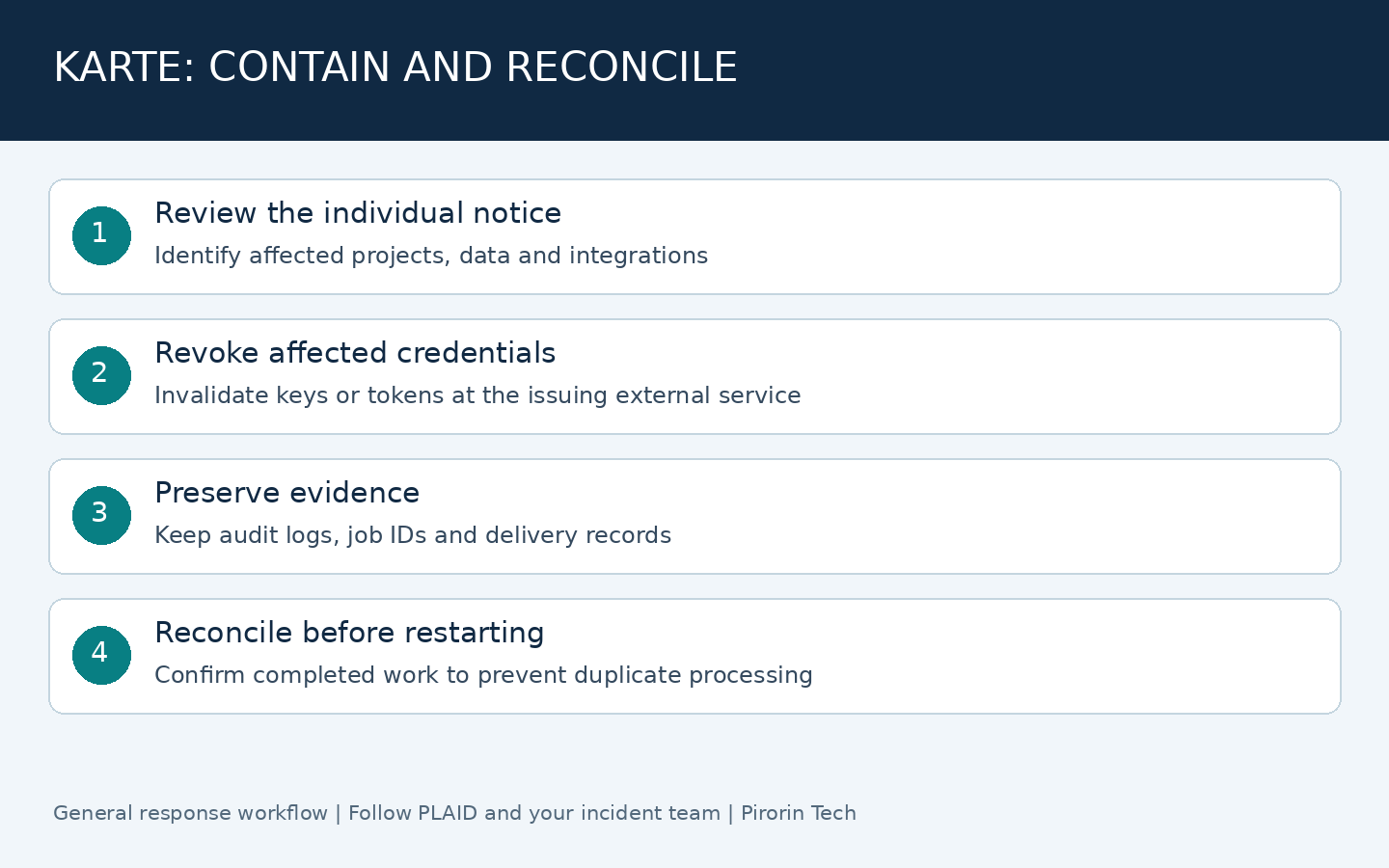
- Find the individual PLAID notice in the registered incident contact or shared mailbox. Confirm the affected project, data and credentials.
- Revoke the affected integration keys or tokens at the issuing external service. Record the credential identifier, scope, owner and revocation time without copying the secret into a ticket.
- Review the external service’s audit logs for unfamiliar reads, writes or exports using that credential.
- Preserve application, job and delivery logs under your normal incident retention process.
- Bring privacy, legal, security and service owners together to determine the investigation and customer communication required for your actual data.
Revocation matters because an integration credential can authorize access to another system. Stopping KARTE alone does not necessarily invalidate a token issued by that external system. Create replacement credentials only through a controlled recovery process and give them the permissions the integration actually needs. These are general incident-handling recommendations; follow the provider’s specific notice for the affected connection.
Email campaigns and data jobs: avoid blind retries
Build a reconciliation list from your campaign plan and the receiving systems’ records. For each job, record the scheduled time, job ID, expected count, completed count and evidence source. Mark uncertain results as unknown instead of assuming that all work failed.
Before restarting a mailing, separate confirmed recipients from unsent recipients. Before replaying a data export or import, check whether the destination already committed part of the job. Use stable transaction or event identifiers to detect duplicates where your system supports them. Keep the original evidence so a later investigation can reconstruct what happened.
Do not promise that missing analytics events will automatically be recovered. Recovery behavior depends on the product, integration and whether the original event was retained.
Does a KARTE outage mean the whole website is down?
It depends on how the site uses the service. Analytics, personalization, embedded support and messaging can be separate dependencies from a site’s core checkout or account system. Test the customer journeys that matter: opening a product page, signing in, submitting an order and contacting support.
This describes system dependency in general. It does not establish that an attacker entered through a browser tracking tag or an app SDK. The exact exploited vulnerability was not identified in the disclosure reviewed here.
What should customers of affected businesses do?
Use that business’s official announcement to identify your data categories and required action. A service may have sent a member identifier to KARTE while another sent names or contact details. Do not transfer a password-reset instruction from one company to another.
Open official apps or saved bookmarks rather than links in unexpected breach messages. A caller who knows your customer details has not proven they represent the company. Never provide an authentication code or approve a login prompt solely because the caller describes the incident.
Frequently asked questions
When will KARTE recover? The November 18, 16:00 JST update did not provide a restart date. Use the live status page and your vendor contact for later information.
Do all customers need to reset passwords? The disclosure does not establish one universal instruction for every downstream customer. Businesses should follow the specific data and credential scope in their notice.
Is the Rakuten Securities incident part of this? Its announcement describes a separate test-environment incident. A link between the two has not been confirmed. See our Rakuten Securities guide.
Related company-specific report: MUFG Bank data exposure: what customers should check. This article covers the incident across KARTE; the MUFG article focuses on its customer notices and exposed information.
Sources and updates
PLAID disclosure, November 16; KARTE live status; Japanese edition. English edition published November 18, 2026 (JST). Operational checklists are general recommendations, not claims that a particular customer’s system was tested.